
Writing
Ten puzzles a day, no answers in the browser
0xDLE started with a simple daily ritual: ten IT puzzles, a fixed order, and a reason to come back tomorrow. The first playable version looked like a normal single-page game. It fetched the day, kept progress in local storage and rendered every task in the browser. It was quick and pleasant to use. It was also the wrong shape for a quiz.
A daily puzzle is a small competition. If the answer key, the correct option index and every alias are already in the browser, the competition is decorative. Anyone can open the network panel, read the payload and finish the day without solving anything. That is not a security theory. It is the first thing a curious player tries.
I rebuilt 0xDLE around a stricter rule: the browser may send a guess, but it never receives the answer key. That decision changed the rendering model, the forms, the score handling and the build. The result is live at 0xdle.rayzen.dev, and the architecture is more interesting than the original client-side version.
The day is made on the server
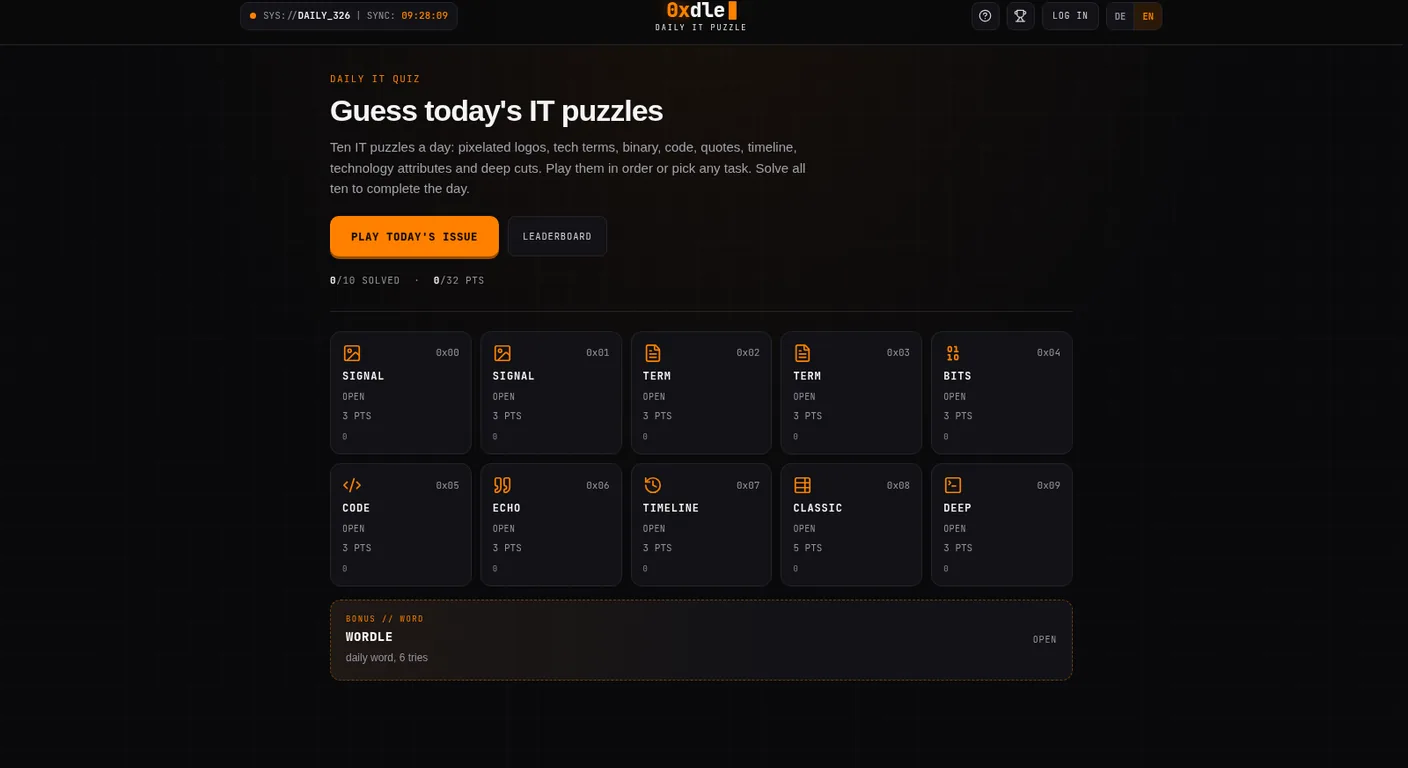
The selector turns a date into a stable set of ten tasks. It keeps the order short to hard, uses the same picks for German and English, and allows an old date to be replayed without silently changing the published day. The content lives in server-only pools: technology marks, terms and aliases, snippets, quotes, timeline events, attribute rows, deep cuts and bonus words. The browser never asks for that catalogue.
That sounds obvious until the work starts. A normal single-page quiz wants a serializable day. It wants the answers nearby so it can compare them locally. It wants the options in the client so it can show immediate feedback. Once the answer cannot cross the boundary, the page has to carry the question and the form, and the server has to own the transition from one attempt to the next.
EJS does the rendering. Fastify handles the routes and form posts. Sequelize and SQLite hold accounts, sessions, solves and per-slot progress. The same content service feeds one rendered page at a time. There is no hidden `/api/day` endpoint that returns the puzzle catalogue, because that endpoint would undo the design.
A guess is a form, not a JSON message
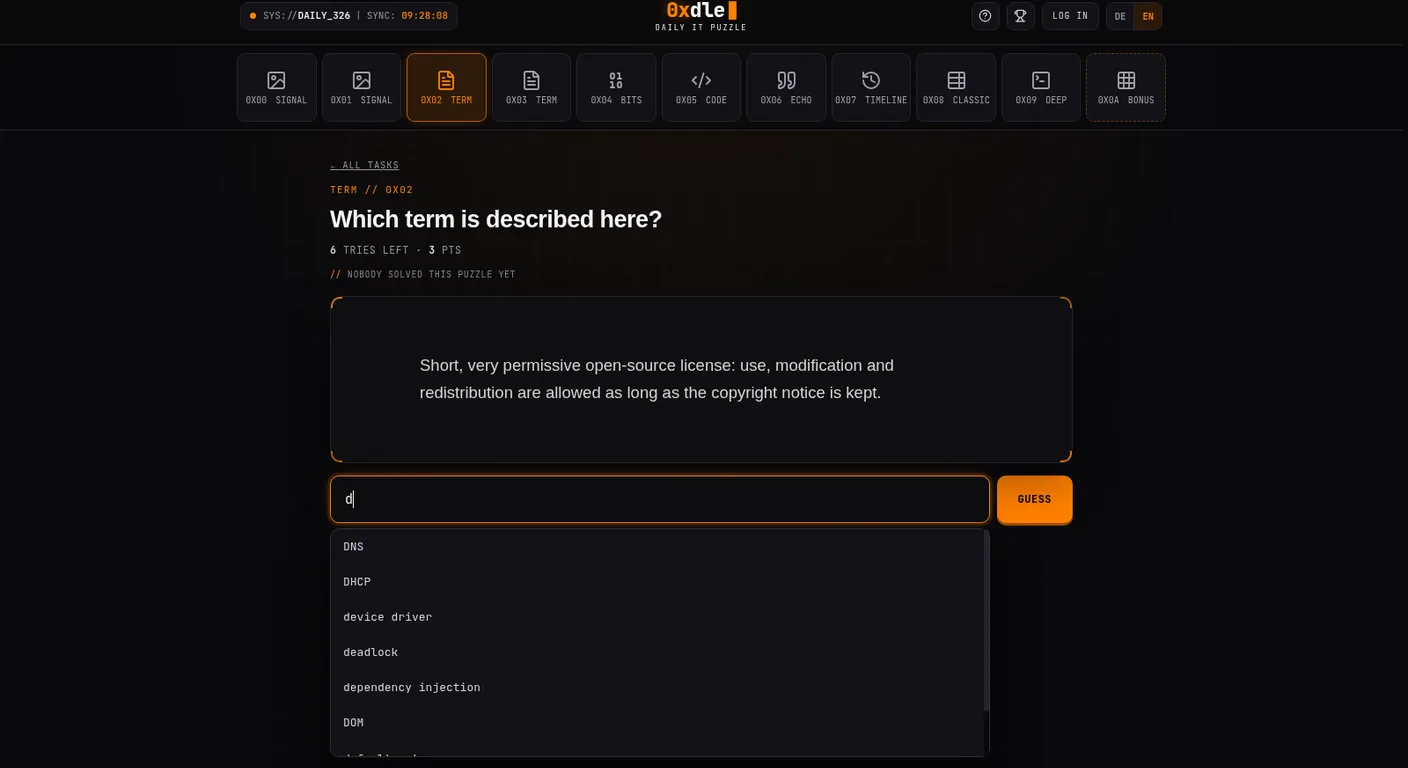
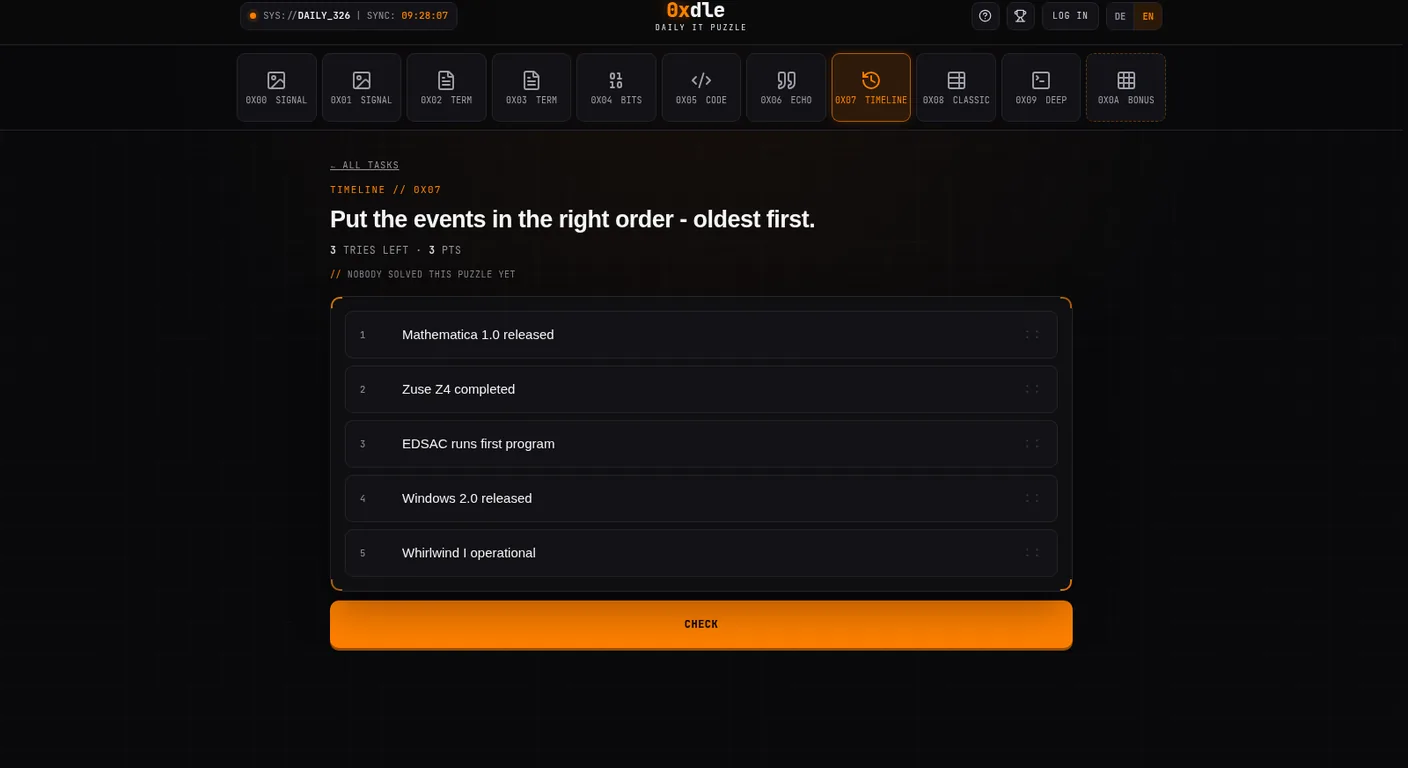
Every mechanic has a normal HTML answer control. SIGNAL, BITS, CODE and ECHO render buttons. TERM, CLASSIC and DEEP render a text field. TIMELINE renders a sortable list and posts the final order. The form goes to the server, the server compares the guess against the internal item, and the response is a redirect back to the task page.
The redirect is not a limitation I forgot to remove. It is the boundary in its simplest form. There is no JSON verdict that a client can inspect for hidden fields, no local score to edit and no answer object to log before the round ends. The page either shows the next attempt or it renders the result.
Scoring follows the same path. A normal puzzle loses points with every failed attempt. CLASSIC has a wider five-point range. The bonus word is separate from the 32-point day and contributes 3, 2 or 1 points to the leaderboard. The server calculates all of it from the row it already owns, not from a number the browser sends back.
What the browser is allowed to know
The public task data contains the prompt, the visible definition or code, the attempts left, the point range, the solve count and the available answer labels. It does not contain the correct option index, the aliases used for matching or the answer itself. The buttons send their position, not a trusted value. A player can tamper with the position and get a different wrong answer, which is not very useful.
SIGNAL deserves its own note because a logo is easy to leak. The icon is rendered as a pixelated raster by a Sharp pipeline on the server. The level of pixelation follows the current attempt. The original mark is only rendered after the task is solved or the attempts are exhausted. The SVG path never becomes part of the task page.
Autocomplete was another small boundary. A suggestion list helps with long technology names, especially in German, but a list that contains the answer is a spoiler. The server sends other labels from the relevant pool and filters by prefix, case-insensitively. The correct target is omitted. The player can still type it, and the server can still validate it. The list is assistance, not an answer.
The weirdest consequence is how quiet the page feels. There is no local game state to inspect, no content bundle to read and no client store to edit. The source is mostly HTML, a small progressive-enhancement script for sorting and dialogs, and the result the server decided to render.
Progress has to belong to someone
Once answers are server-owned, progress cannot live in the browser either. A guest gets an anonymous cookie, and the server creates progress rows for each date and slot. Registering moves the guest solves onto the account, so a player does not lose the first half of a day by creating an account at lunchtime.
The schema stays intentionally small. A progress row records the actor, date, slot, kind, attempts, solved state and the mechanic-specific state. A solve row records the leaderboard event. The leaderboard can then ask for today, this week, this month or all time without scanning a client-side history. Guests are counted in the per-puzzle solve totals, but only registered players appear in the ranking.
SQLite is enough for this shape. The app is a single Fastify process, the write volume is small and the daily reads are short. Sequelize migrations make the schema reviewable. If the game grows into a larger concurrency problem, the boundary is already clear enough to move the persistence layer without rewriting the pages.
The build is small because the page is the product
The production build is not an afterthought. CSS is minified with esbuild. The small client script is minified and then obfuscated. The rendered HTML is minified at request time. The CSS and JavaScript are inlined, so loading a task does not add a separate stylesheet and script request, and the page that arrives is already the page the player sees.
The development experience stays readable. EJS pages, source CSS and the unminified script are easy to inspect while working on a layout. Production runs the same views through the build and the production configuration, which is a useful distinction: I can debug the thing I am editing without making the deployed page larger.
The interface has no large client framework. That keeps the JavaScript small and removes an entire class of state bugs. It also means the browser is doing less work. The 0xDLE page is mostly text, a few small controls and, on SIGNAL, one PNG. There is no reason for the answer engine to ship as a client app.
The trade-offs are visible
Every guess costs a page navigation. That is slower than an instant client reaction, and it rules out optimistic feedback, offline play and a lot of animation that a single-page game would get for free. I accepted it because the alternative was a quiz that could not keep its own answers.
EJS also makes state transitions explicit. A failed guess is a redirect with a status, not a mutation of a local object. That is excellent for correctness and slightly more work for interaction design. The solution was to keep the interface simple enough that a page load does not feel like a penalty. The task page is short, the result is clear and the next action is always one link or button away.
Content is the other cost. A server-rendered quiz still needs a person to curate a definition, the aliases, the distractors and the translation. The software can make the day stable and the answers safe. It cannot make the questions interesting. That part remains editorial work.
What I kept
I kept the plain form. I kept the deterministic day. I kept the server as the only place that knows the answer and the only place that writes a score. I kept the small client script because drag-and-drop and dialogs are worth improving without turning the game into an application.
0xDLE now runs with ten puzzles, eight mechanics, a bonus word, two languages and a leaderboard. The next features are practice and archive browsing, but the core rule will not change. If a page can be read, it should not contain the answer.