
Writing
The password is already in the page
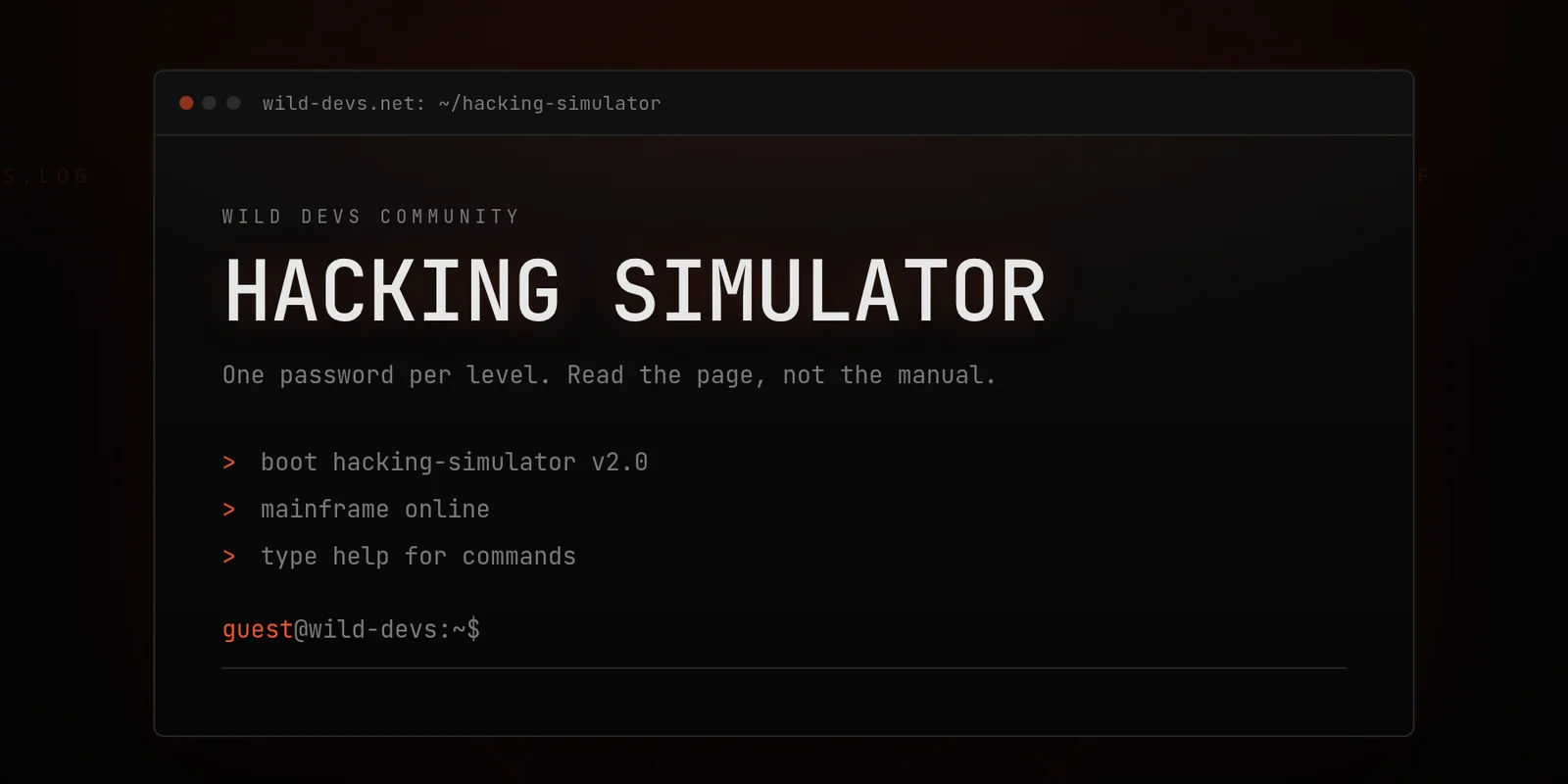
Hacking Simulator is a browser puzzle game with a simple contract: every level hides one password somewhere in the page. The password might be in a source comment, a title attribute, an image, a response header, a stylesheet or a file download. The player has to read the thing the browser actually received, not just the thing the page wanted to show.
That sounds like a small joke about DevTools. It became a 50-level game in five acts, with a story, six speaking characters and a voice for every line. The browser is not a surface the game runs on top of. The browser is the puzzle.
I built Hacking Simulator with the Wild Devs Community. The first act ports the original static PHP version and keeps its story and answers. The later acts continue that story with new mechanics and a real epilogue. The current version is live at hack.rayzen.dev.
The page is the level
A normal browser game hides its state in JavaScript and trusts the player to use the interface. Hacking Simulator does the opposite. The interface can be quiet, but the page has to remain inspectable. A level might put the answer in a hidden element, an accessibility attribute, a response header, a stylesheet rule, a cookie, a query parameter or a file that is downloaded but never displayed.
The mechanics are rationed. Each kind of trick appears once across the game, or at least once in the act where it belongs. That constraint matters. A puzzle game can become a list of repeated tricks very quickly: another Base64 string, another image with text in it, another comment that says the answer. I wanted the player to learn a new way of looking, not to learn the developer's favorite hiding place.
Some levels are almost entirely page source. Others are an image, a terminal, a downloaded ZIP, a PDF or a sound. The player never needs a separate toolkit for the game itself. A browser, a text editor and the curiosity to open the network panel are enough.
The loader is the contract
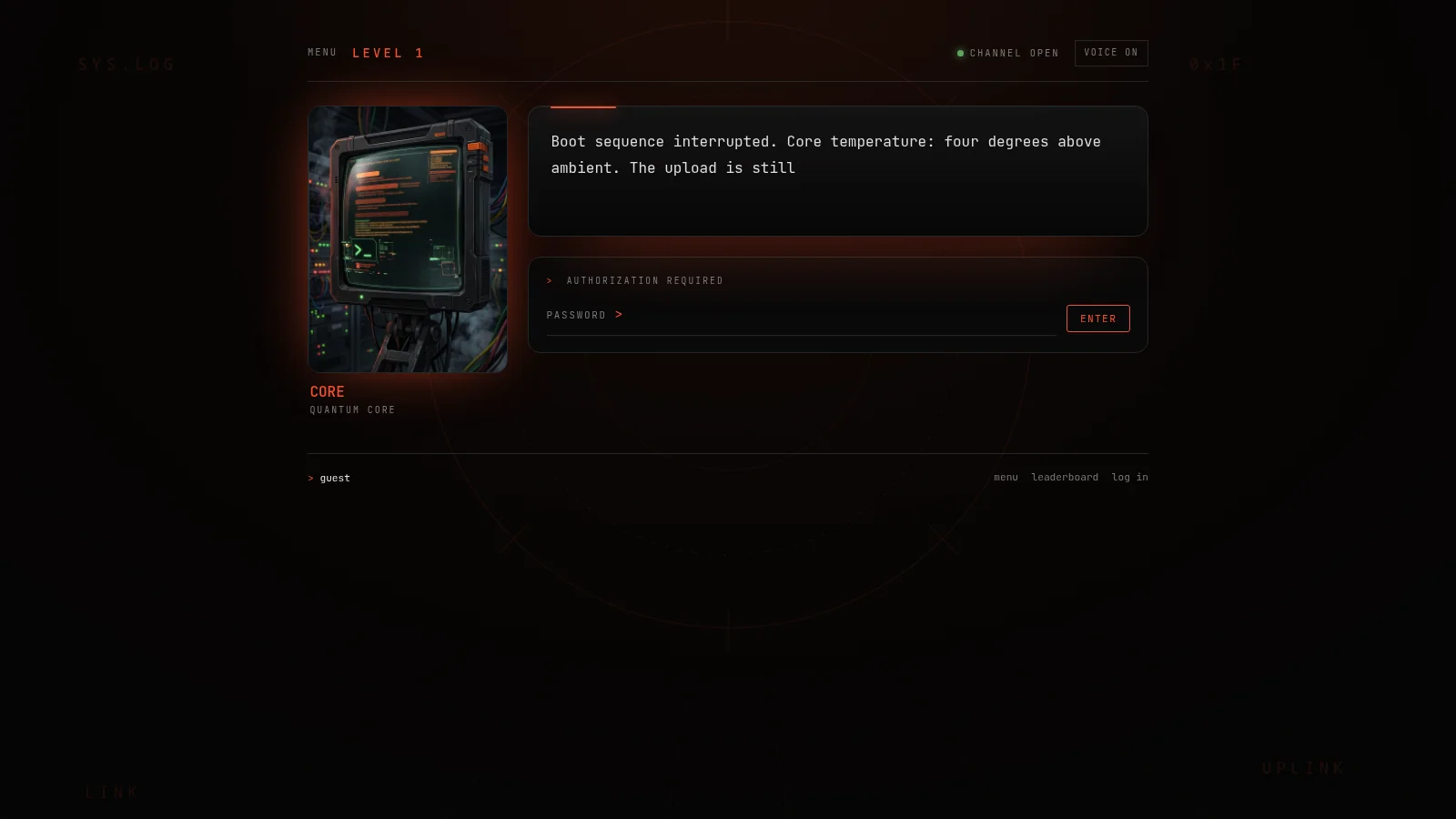
Each level is a JSON file. It contains an id, an optional speaker, dialog scenes, accepted answers and, when needed, trusted clue markup, response headers, a source comment or a per-level title and description. The loader sorts the files, links the chain and refuses to boot when an id is missing, an answer is empty or the data does not fit the contract.
That validation is boring in the best way. A broken level fails at startup, not halfway through a playthrough. The level pages are generated from the same data, so a missing next link or an inconsistent title is not something I have to remember to update in five templates.
The public pages deliberately do not show a level total or a progress counter. Knowing that a page is level 33 changes how a player reads it. The terminal shows commands and responses, not a dashboard. The story can carry the sense of progress; the interface does not need to spoil it.
The leak is the real bug
The hardest test in the project is not whether a level can be solved. It is whether an earlier page accidentally contains a later answer.
Every level page renders dialog, clues, headers and sometimes source comments. A small mistake, such as an image filename, an accessibility label or a debug message, can put a future password into the page source. Once that happens, the game is not difficult. It is solved by opening the first page and searching for strings.
The leak test walks every level and checks every answer from every later level against the page. It strips the site's own hostname before scanning so a domain name cannot count as an answer by accident. The test also covers the epilogue. That is why a character portrait uses an internal filename instead of the character's public name when the public name is also a puzzle answer. The asset has to be safe to serve on every page, not just the one where it appears.
This is the part of game design that looks like security work. It is not enough to put the answer behind a route. The answer must not leak through the UI, the assets, the metadata or the story.
Story and voice
The game is a tribute to the feeling of an old terminal story, updated for the browser. CORE is the system. VOSS is the voice on the radio. MARA is dry, ASH is distant, KESTREL sounds like a wide walkie-talkie and ADRIAN VOSS is the person behind the company. The player is the friend who helped put a dying scientist into a quantum core, and the story follows what the core learns to want.
Every dialogue line in all 50 levels and the epilogue is spoken. The audio is stored as one file per line, so the typewriter and the voice can stay in sync. The player can mute the voice, and that choice stays in the browser. The voice set was generated locally with Qwen3-TTS and a character voice pipeline. There is no third-party voice service in the page.
The voices are not a decoration added after the puzzles. They set the pacing. A line of dialog is short because it has to be read and heard while the player is already thinking about the next clue. The interface gives the story room, but it never lets the story turn into a cutscene the player has to wait through.
A terminal instead of a menu
The start screen is an actual terminal. You type commands. register creates an account, login signs in, play resumes the next level, leaderboard prints the top ten and help lists the rest. Up and Down walk through history. A guest can play without registering.
The terminal is also the first place where the game states its terms. It does not print the level count. It does not show a progress bar. It gives the player a prompt and waits. That choice made the rest of the interface easier: there is no dashboard to keep consistent, no modal hierarchy to design around and no second navigation system. The story pages can be pages.
Without JavaScript, the terminal falls back to links for registration, login and guest play. Accounts are optional. The leaderboard is there for the people who want one, not as a gate in front of the game.
Small stack, large content surface
The implementation is deliberately small. The server is Fastify with EJS templates and node:sqlite. There is no native database driver, no frontend framework and no build step for the game client. The pages are server-rendered, the CSS is ordinary CSS and the browser JavaScript is there for the terminal, the typewriter, progress bookkeeping and the voice button. Fonts are self-hosted.
The content is where the weight lives. Fifty levels mean fifty stories, fifty clues, fifty sets of accepted answers and a voice file for every line. The solution books in German and English are generated from the same data. The level chain is validated in tests. The assets are checked against a lock file so an active puzzle image cannot be silently re-encoded or replaced.
That is a different kind of complexity from a realtime system, but it is still systems work. The content has a schema. The loader has a contract. The leak invariant has tests. The story has a runtime. A small stack does not mean a small project; it means the project's difficult parts live in the content and the invariants instead of in the framework.
What the player sees
Hacking Simulator is playable at hack.rayzen.dev. It has 50 levels across five acts, a terminal start screen, optional accounts, a leaderboard, a voiced story and a full spoiler book for anyone who gets stuck. The case study is at rayzen.dev/work/hacking-simulator.
The browser is a strange place to hide a password. It is also the only place this game could work. The page is the level, the source is the clue and the player's best tool is the one already open in the other tab.