
Case study · 03
0xDLE
A bilingual daily IT quiz with ten puzzles, eight mechanics and a bonus word. The answer key stays on the server.
Context
0xDLE is a daily IT quiz for trainees, working developers and engineers who want ten small puzzles with their coffee. Each day has ten tasks in a fixed order, from a pixelated technology logo to a deep cut that takes more than pattern matching.
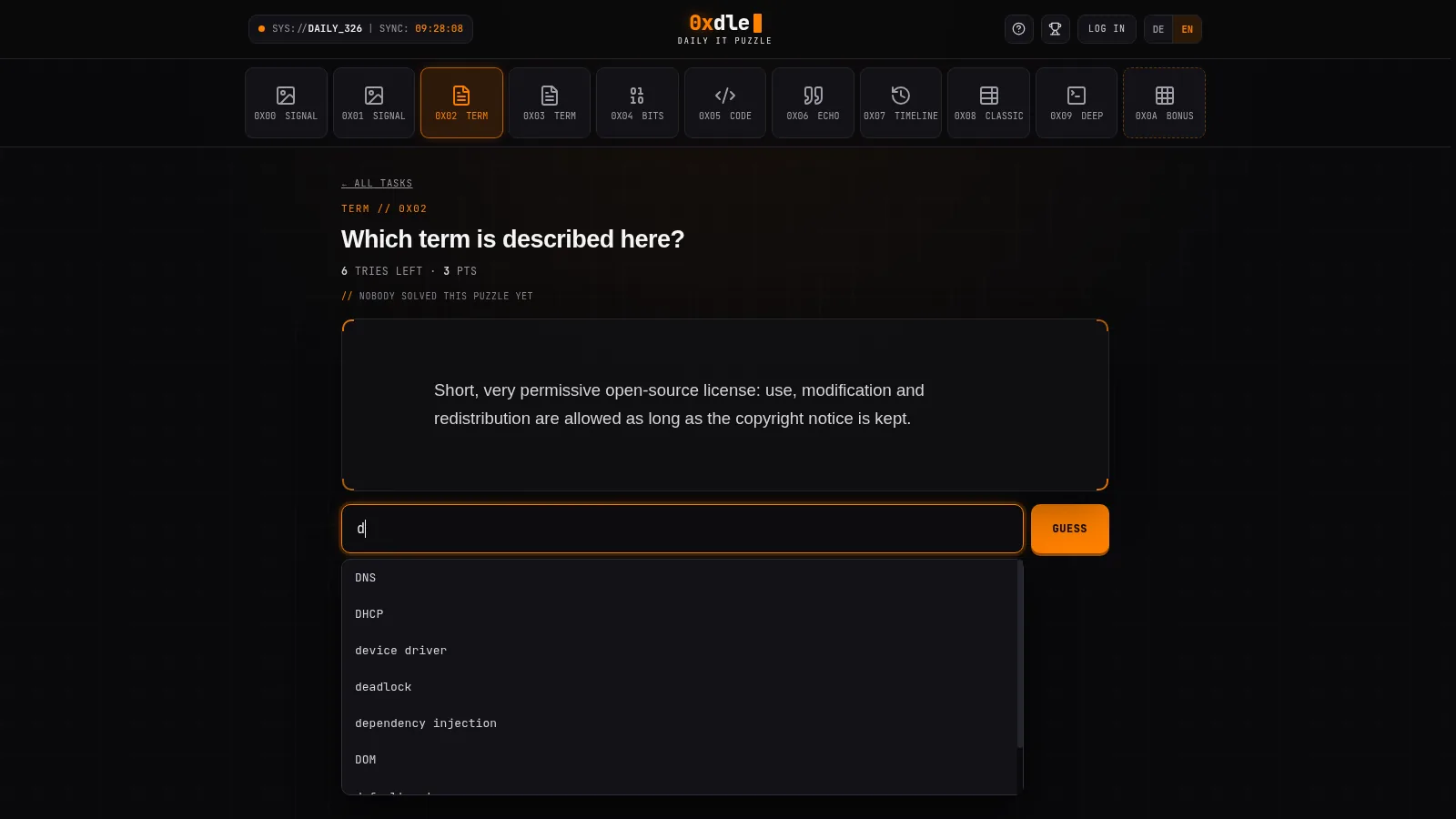
The mechanics are SIGNAL, TERM, BITS, CODE, ECHO, TIMELINE, CLASSIC and DEEP. A separate BONUS word is the eleventh tab. The interface is bilingual from the first day: German and English definitions, explanations, questions and answers.
Role and constraints
I built the product end to end: content model, deterministic daily selection, game rules, server-rendered pages, accounts, guest progress, leaderboard, production build and deployment.
The main constraint was not visual. It was the trust boundary. A quiz where the browser receives the answer key is not a quiz, it is a reveal waiting for a browser extension. That ruled out the usual single-page shape and made the rendering model part of the game design.
- Ten tasks a day, no client install, no pay-to-win and no daily download of a content pool.
- One server-side day, one scoring path, one progress record per player and slot.
- German and English content live together so switching language does not change the puzzle.
Architecture
The application is a Fastify 5 monolith. EJS renders the pages, Sequelize owns the SQLite schema, and a small service layer handles content selection, game rules, progress, accounts and the leaderboard. The day is drawn from the date; the browser never asks for a content catalogue.
The production build removes the readable client. CSS is minified with esbuild, the small progressive-enhancement script is minified and obfuscated, and final HTML is minified at request time. In development the same pages remain readable so the layout can be worked on without a build step.
- Fastify routes and controllers for pages, form posts, health, icons and auth.
- Sequelize models for users, sessions, solves and per-slot progress.
- Server-only content pools and a Sharp pipeline for pixelated SIGNAL images.
- PM2 and a reverse proxy in front of a single production process.
One day on the server
The selector turns the calendar date into a stable day. It keeps a fixed short-to-hard order, uses the same picks in both languages and lets an old date be replayed without changing what was published. BITS is generated; every other mechanic is curated and bilingual.
A task page is an ordinary form. A TERM answer is checked against aliases after normalisation; a CODE or ECHO choice is compared by option identity; TIMELINE sends the order of five events; CLASSIC compares attribute rows; DEEP checks the accepted answers. The response is a redirect, not a JSON verdict.
Progress is stored per actor, date and slot. A guest gets an anonymous cookie and keeps their tries; registering moves those solves to the account. The leaderboard reads the recorded solves for today, week, month or all time.
The answer boundary
The public task payload contains no correct option index, no alias list and no answer. Options are shuffled by the server, rendered as buttons, and the button itself only sends its position. A page has to be solved before the answer is placed in the HTML.
SIGNAL is an image pipeline rather than an SVG in the document. The server renders a pixelated raster at the current attempt level and only returns the sharp mark after the task is solved or exhausted. Autocomplete is a prefix list from the pool with the target answer removed, so it can help with typing without handing over the answer.
That boundary is also why the interface looks quieter than a typical quiz app. There is no local score state to inspect and no client content bundle to read. The cost is a page navigation on every guess, which is a fair trade for a daily puzzle.
Status
0xDLE is live at 0xdle.rayzen.dev. It has the ten daily tasks, the bonus word, accounts, guest progress, solve counters and the four-period leaderboard.
The next work is archive browsing, practice mode and a wider content pipeline. This case study documents the system that exists now, not a roadmap disguised as a finished product.